
You have lost more years to your own thinking than to any person who ever wished you harm.
Count them honestly.
- Every plan you killed before day one.
- Every message you rewrote nine times and never sent.
- Every night you replayed some old conversation and fought a version of yourself nobody else even remembers.
No rival arranged any of this.
You did. So when you ask ‘who is your enemy?’ start much closer to home than you would like.
We spend our lives scanning for danger outside. Meanwhile, someone sits inside your skull.
He knows every password. He remembers each failure by date. He speaks in a voice you trust completely, because you believe the voice belongs to you.
Your ancestors feared things they could see, and you inherited their alarm system
Early humans had simple problems.
Hunger, cold, teeth in the dark. Their fear came with an address. Run from the sound, and safety arrives.
Your fear has no address. Nothing chases you, yet your chest tightens at 2 a.m. over an unanswered email.
Evolution handed you a threat detector built for predators, then dropped you into a life of deadlines, comparison, and silence from people you care about. So your detector turns around and hunts inside.
You become the lion.
Seneca noticed this two thousand years ago.
We suffer more in imagination than in reality.
Nothing has changed since he wrote those words, except the size of our imagination.
Your mind is your worst enemy because it never announces itself as one
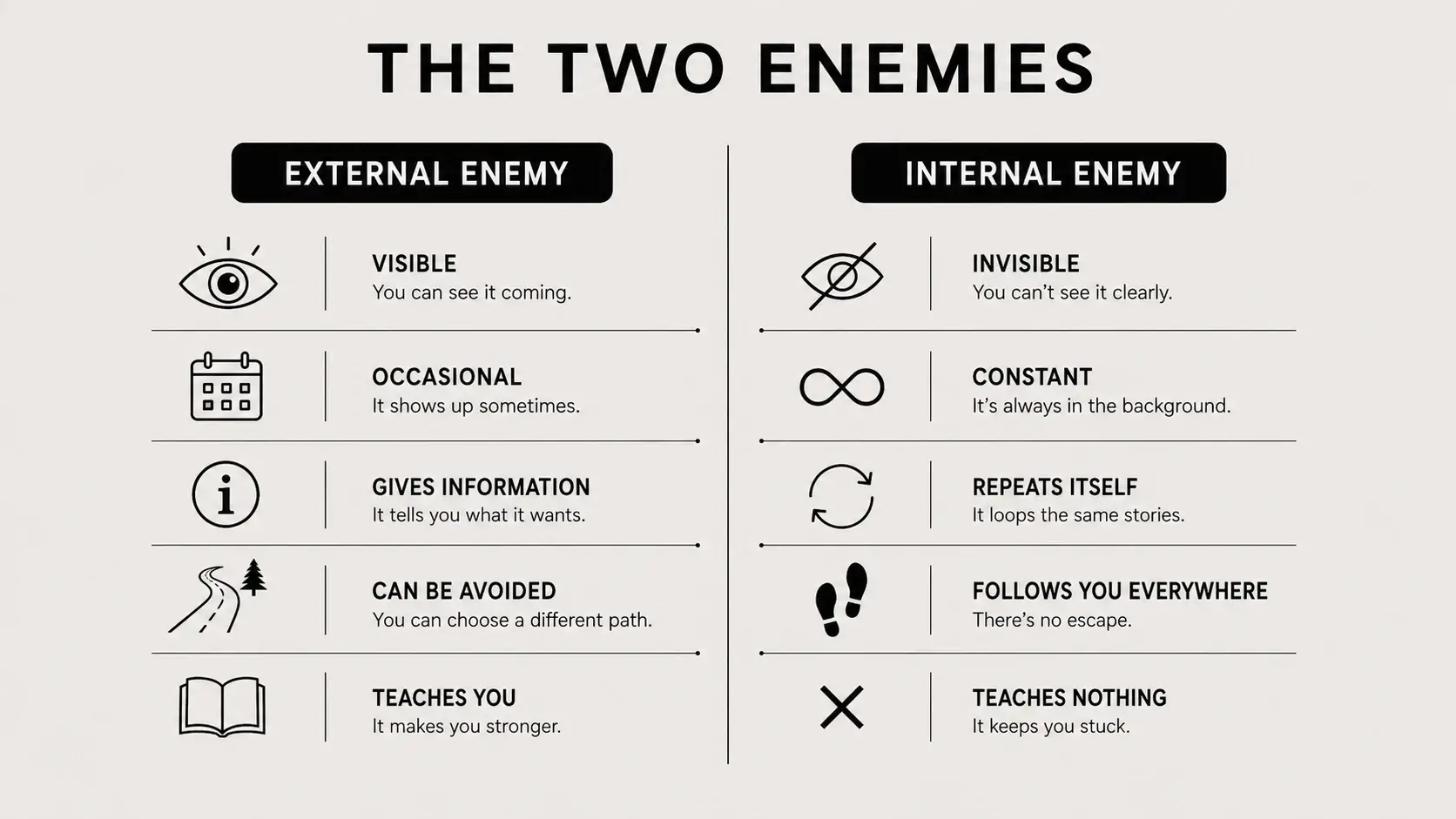
An external enemy has to show up. You see a face. You hear a tone. You feel a slight, and you get to respond.
Your inner enemy never shows up. He arrives dressed as reason. He sounds calm, mature, even wise. When he tells you to wait one more month before launching, you call it planning.
When he lists nine reasons why you would embarrass yourself, you call it self-awareness.
Therefore, you never fight back. Who fights his own good judgment?
Steven Pressfield gave this force a name in The War of Art.
He calls it Resistance, and he describes it as invisible, patient, and always strongest right before your best work. Resistance does not scream. Resistance whispers, and whispers win, because you mistake them for your own thoughts.
This is the whole problem.
Your biggest enemy is yourself, and self cannot be exiled, blocked, or reported.
You carry him to every city you move to. He shares your bed.
Why are we our own worst critic, and where did the habit actually begin?
Ask anyone. We are our own worst critic, and everyone nods as this counts as a personality quirk. Something deeper runs underneath, and it overlaps heavily with the reasons self-doubt takes hold in the first place.
Self-attack once kept you safe
Small children survive by staying acceptable to adults. So a child learns to police himself before anyone else can. Criticism becomes armour. Decades later, the armour still runs, though the danger left long ago.
Punishment feels like control
Something terrible happens, and you cannot fix it. Blaming yourself restores a sense of power. Guilt hurts less than helplessness.
You know too much
Others judge your surface. You judge your motives, your private cowardice, your 3 a.m. thoughts. Nobody else has access to that footage, so nobody else can build a case that cruel.
Harshness feels like standards
Many people fear that self-kindness will make them soft. So they keep the whip, and confuse pain with discipline.
Marcus Aurelius wrote in Meditations that you have power over your mind, and no power over outside events. Most of us reverse his instruction perfectly. We fight the world and surrender the mind.
The five faces of your inner enemy
You cannot beat what you cannot recognise. Your inner enemy uses a handful of disguises, and each one has a tell.
- The Rehearser. He runs disasters in advance. Fifty imagined versions of tomorrow, forty-nine of them painful. You feel exhausted before you begin, and exhaustion looks like proof of difficulty.
- The Prosecutor. He drags up 2016 while you brush your teeth. His evidence stays selective, his verdict stays fixed, and he never allows a defence.
- The Comfort Dealer. He speaks softly. Rest today. Start Monday. You deserve a break. His kindness costs you a decade.
- The Scoreboard. He measures your chapter three against another person’s chapter twenty, then hands you a number and calls it your worth.
- The Gatekeeper. He guards identity. You’re not a writer. You’re not a business guy. You’re not the type. He blocks you from becoming anything by insisting on what you already are.
Notice how reasonable each voice sounds alone. Notice how devastating they become together. The Gatekeeper does the quietest damage of all, because identity feels like fact rather than opinion, and confidence has to be rebuilt at that level before anything else moves.
Add up what this habit has already taken from you
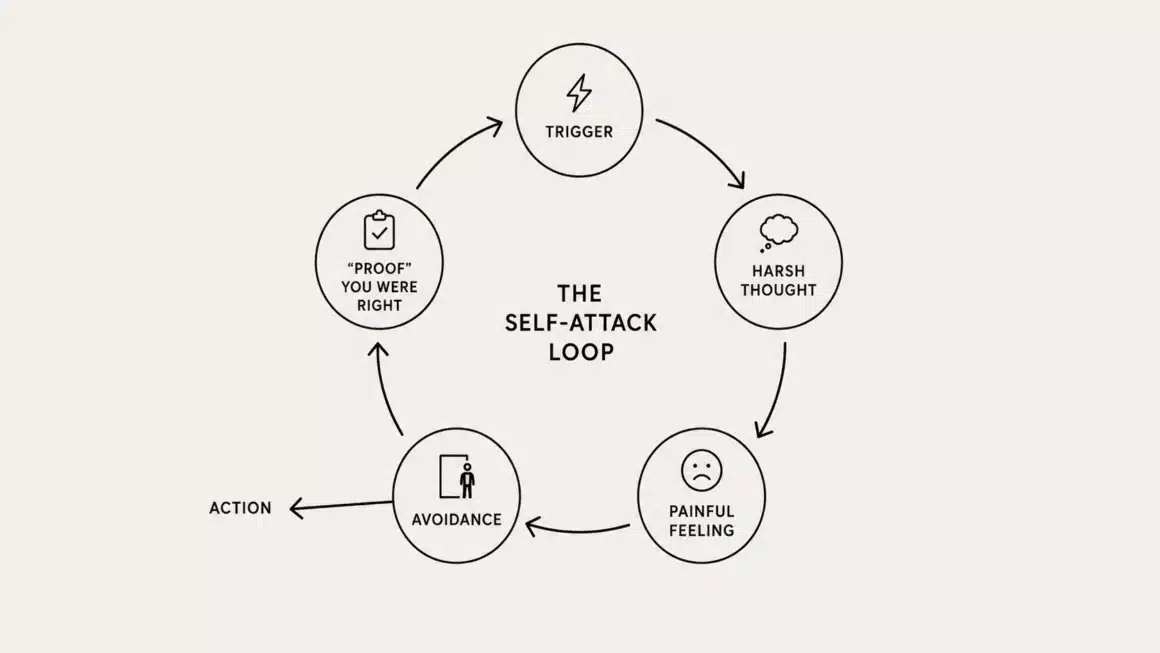
We track money. We track weight, steps, screen time, and calories. Nobody tracks the cost of self-attack, so the bill grows quietly.
Sit with your own numbers for a minute.
- How many ideas did you bury before anyone saw them?
- How many people never heard what you actually thought?
- How many opportunities passed while you waited to feel qualified?
- How many good days got ruined by a mood you built yourself?
Multiply by years. Look at that figure. Much of what we blame on bad timing sits in that column, which is worth remembering whenever you wonder why your turn never seems to arrive.
No enemy on earth could have done that much damage to you. He would need access to your calendar, your ambitions, your childhood memories, and your bedroom at midnight. Only one person holds all four.
Here comes the cruel part. You paid this bill, and you also volunteered as the collector.
So who is your enemy, if the rival you resent keeps making you sharper?
Now for a strange truth. Your outer rivals help you far more than your inner ones ever will.
A rival gives you information. He shows you a gap, and gaps can be closed. He shows you a different way of seeing a problem, and often that way works better than yours. He forces you to sharpen, prepare, and stop coasting.
Nietzsche understood this trade deeply.
One repays a teacher badly by remaining only a pupil.
Your competitor teaches for free. He costs you nothing except pride. However, your inner enemy teaches nothing at all. He only repeats. He gives no new data, no gap analysis, no better method. He runs the same three sentences for thirty years and calls himself your conscience.
So when you say you’re your own worst enemy, understand what you actually mean. Everyone outside gives you something. Only the voice inside takes without paying.
You cannot kill an enemy who lives in your head, so strip his authority instead
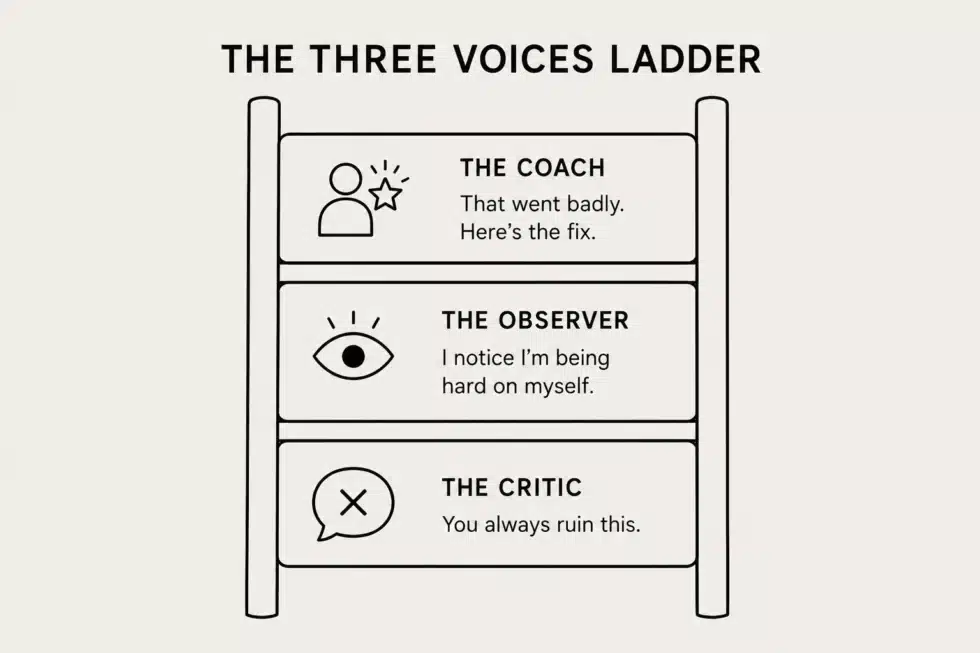
You cannot kill this enemy. Anyone selling permanent silence is selling something. Yet you can strip his authority, and stripped authority changes everything.
Harold Kushner asked a similar question after losing his son, and we unpacked his answer in our notes on When Bad Things Happen to Good People.
Viktor Frankl survived four camps and reached a conclusion that outlasted his captors. Everything can be taken from a person except one thing: the freedom to choose a response.
Your inner enemy owns the first thought.
He never owns the second one. It belongs to you, and every method below simply widens it.
Give the voice a name
Speak to yourself in third person during a spiral. Instead of I’m going to fail, use your own name. Rahul is worried he’ll fail. Psychologists call this distanced self-talk, and research from Ethan Kross and his team at the University of Michigan found that people who switched to third person calmed down faster. Naming creates space. Space creates choice
Demand evidence like a lawyer
Your inner critic never gets cross-examined, so start now. Write his exact accusation. Then write three facts that support him, and three that break him. His case usually collapses on paper, because his power comes from speed and volume, never from proof.
Move before you feel ready
Motivation follows action far more reliably than action follows motivation. Ten minutes of work kills more doubt than ten hours of thinking. Therefore, treat mood as weather. You go outside anyway. We wrote a fuller method for starting the thing you keep postponing, and every step in it works against the Comfort Dealer.
Change his tone, keep his standards
Self-kindness and high standards live together comfortably. Speak to yourself the way a great coach speaks to a talented player who just lost. Direct about the mistake. Certain about the comeback. Kristin Neff has spent two decades studying this, and her published work on self-compassion shows the supportive stance produces more discipline than harshness, along with less burnout. Anyone who has felt like nothing they give is ever enough already knows what the harsh version costs.
Set a deadline on rumination
Give the Prosecutor a scheduled slot. Fifteen minutes, same time each day, notebook open. Outside that window, you postpone. Sounds mechanical, however it works, because your mind stops treating every stray thought as an emergency summons.
What happens when you finally look at him
Something unexpected waits at the end of this fight.
Sit with your inner enemy long enough, and you notice how young he sounds. Painful feelings usually carry a job, a point we made while arguing that Sadness has fooled all of us. Underneath his cruelty runs terror. He attacks you first so the world cannot. He shrinks your ambitions so failure stays small. He replays old humiliations so you never walk into one again.
He operates as a bodyguard who lost his mind, and he has been working double shifts since you were seven.
You still cannot let him drive. However, you can stop hating him, and something shifts once you stop. Energy spent on internal war becomes available for actual work. Carl Jung wrote that people become enlightened by making the darkness conscious rather than by imagining figures of light. Consciousness ends the ambush. An enemy you can see becomes an enemy who can be handled.
The war you were built for
Your enemy will outlive every plan you make to destroy him. He will greet you tomorrow, quieter maybe, still fluent in your weaknesses, still holding a file with your name on it.
Fine. Let him.
A life without inner opposition would produce nothing worth reading, nothing worth building, nothing worth becoming. The pressure that threatens to crush you also shapes you. Nietzsche wrote in Thus Spake Zarathustra that you must have chaos within to give birth to a dancing star, and your chaos arrived long before your ambition did. Whether you spend your years fighting it or dancing with it stays your call, and you make that call fresh every single morning.
So stop searching the room for who ruined your decade. Stop rehearsing the argument with your rival. Go find the mirror instead.
Sit down. Learn the face. Then get to work.
Keep reading
- 8 reasons why we self-doubt, and 10 ways to stop it
- Growing through grace, and 3 ways to apply it
- The true definition of success in life
Free · Weekly