
There is a strange possibility hiding inside the AI boom.
We may become extraordinarily good at getting things done while becoming less capable of doing them ourselves.
Think about how quickly this has happened. A difficult question can be answered in seconds. A blank page can be filled before the first sentence has properly formed in your head. A complicated decision can be handed to a chatbot. A book can be reduced to ten points. An argument can be polished before you have worked out whether you believe it.
Convenience feels harmless when it arrives one shortcut at a time.
Yet every shortcut changes something.
The uncomfortable question is no longer whether AI can think. We already know it can perform tasks that look remarkably close to reasoning.
The uncomfortable question is whether we are still doing enough thinking of our own.
Is AI making us stupid?
The phrase sounds provocative, almost childish. It also points toward a serious problem.
AI does not suddenly remove intelligence from someone’s brain. The concern lies elsewhere. Human abilities become stronger through practice, and weaker through neglect. Reasoning, writing, memory, judgment, attention, and creativity all need regular use.
Imagine learning to play the piano.
You could spend months practicing scales, making mistakes, struggling through difficult pieces, and slowly developing control.
Or you could listen to an expert pianist play every song while telling yourself you are improving because you understand what good music sounds like.
Knowledge has increased. Skill has not. A similar distance can appear with AI.
Asking for an answer is easy. Building an answer is harder. Yet the harder process often contains the learning.
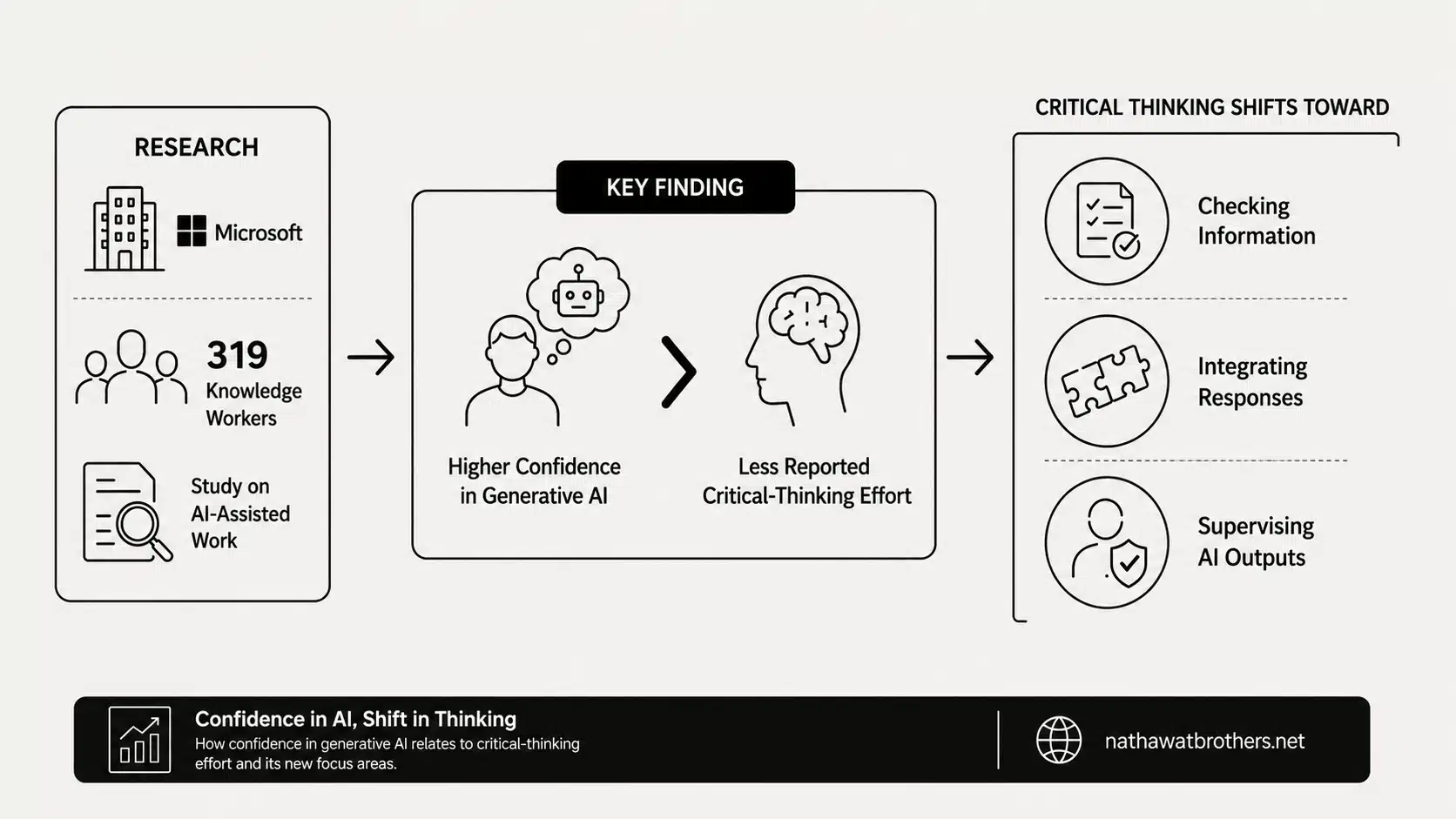
Research from Microsoft involving 319 knowledge workers found an important pattern. Higher confidence in generative AI was associated with less reported critical-thinking effort during AI-assisted work. Participants also described critical thinking shifting toward checking information, integrating responses, and supervising AI outputs.
The finding deserves careful interpretation.
It does not prove that AI is making us dumber.
It suggests something more interesting. When we trust a system more, we may delegate more of the thinking to it.
The real cost of AI overuse
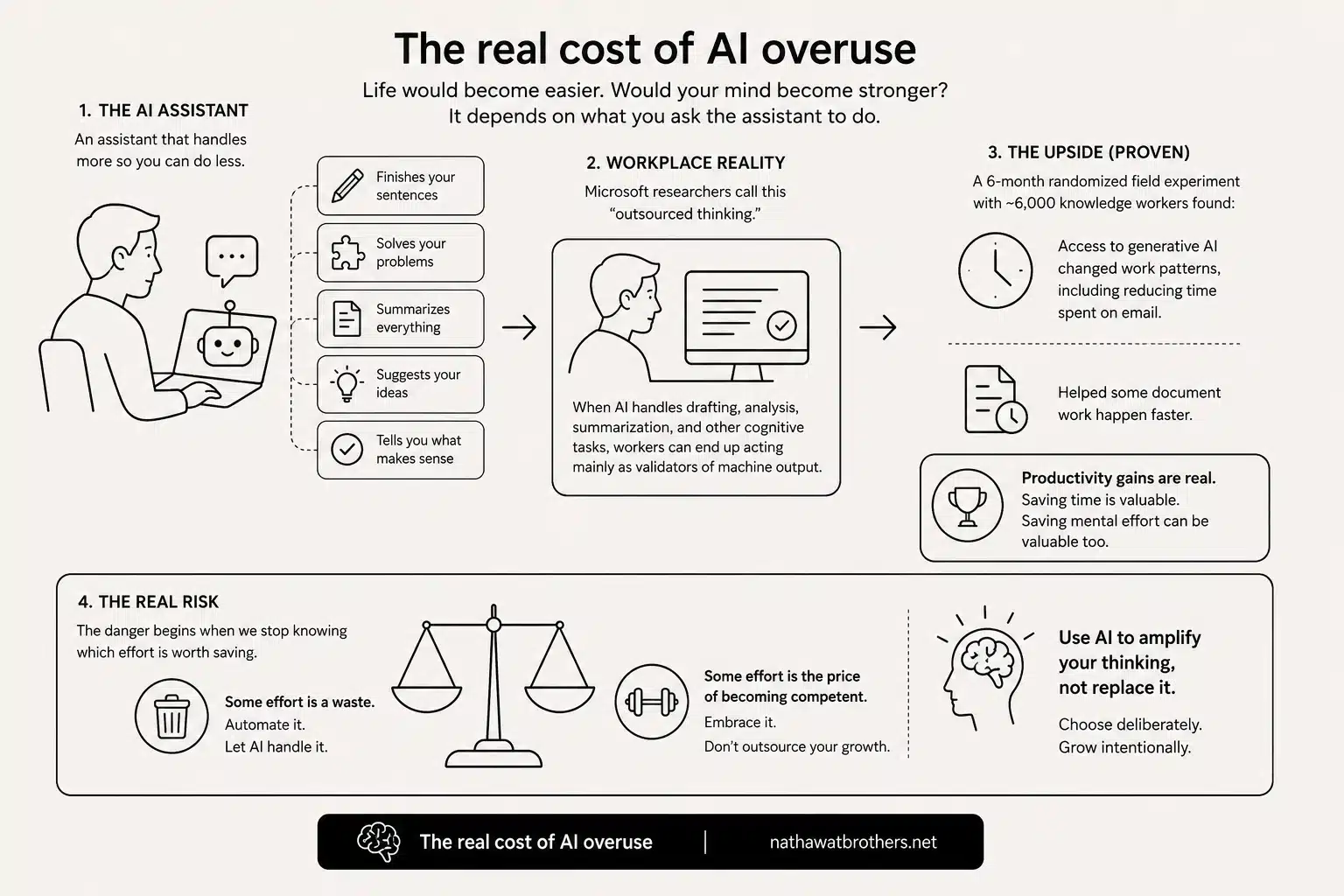
Imagine spending every day with an assistant who finishes your sentences, solves your problems, summarizes everything you read, suggests your ideas, and tells you what decision makes the most sense.
Life would become easier. Would your mind become stronger? Probably depends on what you ask the assistant to do.
Microsoft researchers have already described a workplace risk they call outsourced thinking. When AI handles drafting, analysis, summarization, and other cognitive tasks, workers can end up acting mainly as validators of machine output.
Productivity gains are real.
A six-month randomized field experiment involving about 6,000 knowledge workers found that access to generative AI changed work patterns, including reducing time spent on email and helping some document work happen faster.
Saving time is valuable.
Saving mental effort can be valuable too.
The danger begins when we stop knowing which effort is worth saving. Some effort is a waste. Some effort is the price of becoming competent.
Is AI dulling our minds?
Think about the last difficult problem you faced.
Did you sit with it for a while?
Or did you immediately ask AI?
The difference seems tiny. Psychologically, it can be enormous.
When you struggle with a problem, your brain searches, compares, rejects, revises, and connects ideas. Confusion becomes part of the process. So does frustration.
AI can remove much of that friction.
Conveniently, friction is often where understanding grows.
Reading a difficult book without a summary forces you to build your own interpretation. Writing a rough first draft forces you to discover what you actually believe. Making a decision without immediately asking for ten perspectives forces you to examine your own priorities.
Those experiences create something that a polished answer cannot provide as easily.
Ownership of thought.
We should be especially careful with the first answer.
The first explanation we hear can shape the way we understand everything afterward. The first business idea can narrow later ideas. The first interpretation of an argument can quietly become our conclusion.
AI is exceptionally good at giving us a first answer.
Human thinking needs the freedom to produce one.
How does AI affect critical thinking?
Critical thinking has never meant knowing every fact.
It means being able to examine information with some resistance.
You question the premise. You look for missing evidence. You notice contradictions. You ask what would change your mind. You separate confidence from truth.
AI can help with all of these tasks. Used carelessly, it can make them less necessary.
Suppose you ask an AI system for an explanation of a political issue, a scientific claim, a business strategy, or a philosophical argument. The response may arrive with perfect structure and confident language.
Your brain sees order.
Order can feel like truth.
This is where critical thinking and AI need to become partners rather than competitors.
A stronger workflow might look like this.
- Form your own initial view.
- Ask AI to challenge it.
- Request opposing interpretations.
- Check important claims against primary sources.
- Decide what you believe after seeing the disagreement.
Now AI becomes a pressure test.
The machine does some of the work without taking ownership of the conclusion.
That distinction matters.
Is AI making us less creative?
Research gives us a surprisingly complicated answer.
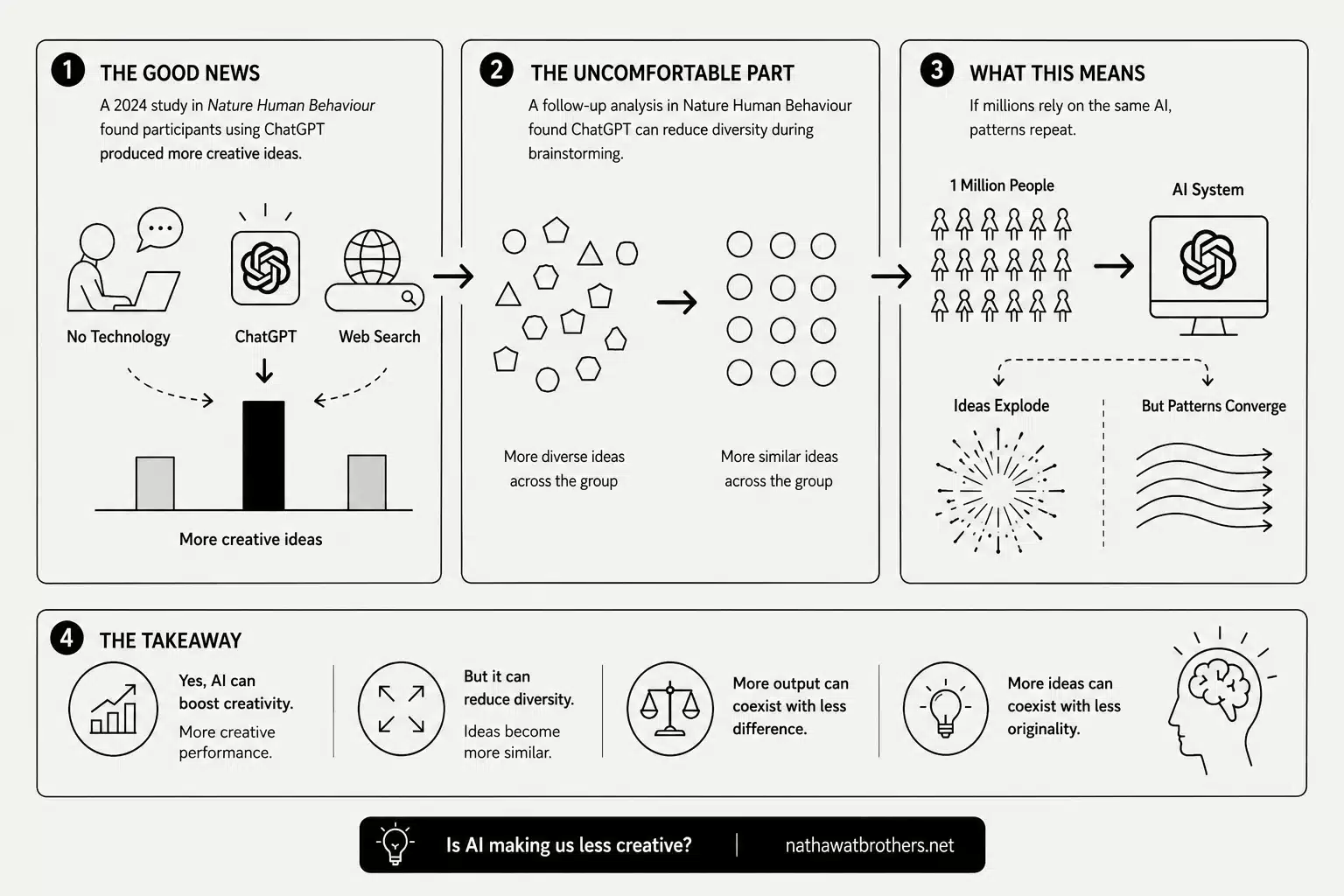
One 2024 study published in Nature Human Behaviour found that participants using ChatGPT produced more creative ideas than people working without technology or using conventional web search.
So yes, AI can increase creative performance.
Then comes the uncomfortable part.
A follow-up analysis published in Nature Human Behaviour found evidence that ChatGPT could reduce diversity during brainstorming. Individual ideas could become stronger while ideas across the group became more similar.
Think about what this means for creativity and AI.
Suppose one million people ask an AI system for an original business idea.
The number of ideas explodes.
But if the same models guide those people toward similar patterns, the creative landscape can become narrower underneath all that volume.
More output can coexist with less difference.
More ideas can coexist with less originality.
Is AI a threat to human creativity?
Human creativity has one advantage machines struggle to reproduce cleanly.
We live inside our material.
Pain becomes an idea. Love becomes a story. Failure changes our judgment.
Childhood memories influence what we notice.
A strange conversation becomes a metaphor five years later.
A machine can combine patterns from an enormous amount of information. Human beings add the unpredictability of lived experience.
Recent research published in Nature Human Behaviour compared 9,198 humans with hundreds of thousands of LLM observations on divergent creativity. Human creativity was slightly higher on average, with a much wider spread at the extreme high end.
The result should change how we talk about AI impact on creativity.
Human originality is not valuable because humans always produce better first drafts.
Human originality is valuable because some humans produce ideas that sit far outside the expected range.
AI can help us explore more territory.
We still need someone willing to leave the map.
The danger of outsourcing judgment
Creative work gets most of the attention. Decision-making may be even more important.
- What should I do next?
- Should I accept this job?
- Should I leave this relationship?
- Should I publish this idea?
- Should I move to another city?
- Should I start the business?
AI can provide arguments, probabilities, frameworks, pros and cons, and possible outcomes. Useful information can become dangerous when it quietly becomes borrowed judgment.
A decision is not merely a calculation.
Your values matter. Your priorities matter. Your tolerance for risk matters. Your history matters.
Sometimes the most important part of a decision is discovering why you want one option more than another.
That requires introspection.
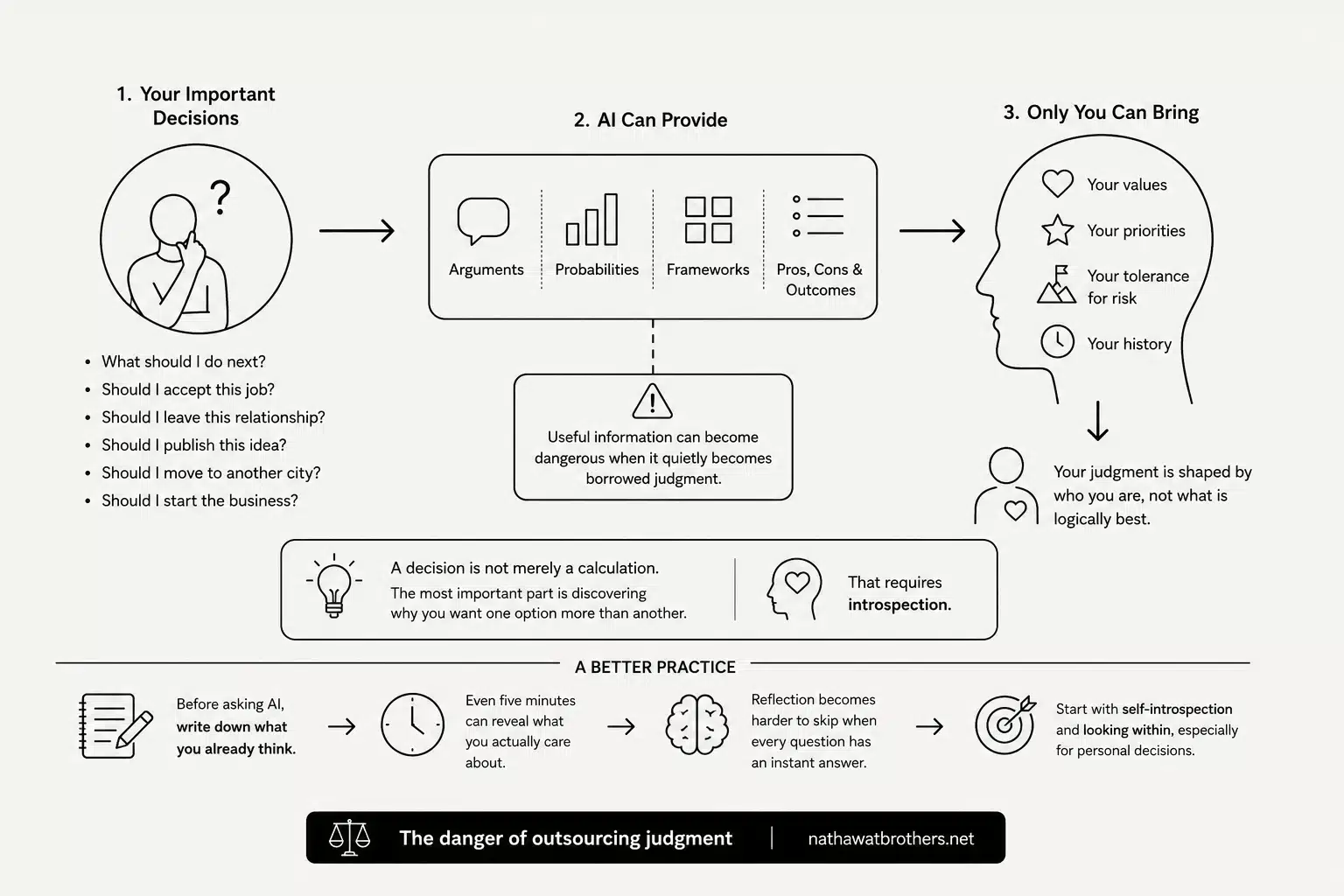
A useful practice is to pause before consulting AI and write down what you already think. Even five minutes can reveal what you actually care about. Reflection also becomes harder to skip when every question has an instant external answer.
One useful starting point is the practice of self-introspection and looking within, especially when the problem involves personal judgment rather than factual information.
What should we keep doing ourselves?
AI should remove useless work.
It should not remove every opportunity to develop competence.
Keep some tasks deliberately human.
- Write the first draft yourself.
- Solve difficult problems before asking for solutions.
- Read important material before requesting a summary.
- Form an opinion before asking for one.
- Ask AI to criticize your reasoning instead of always generating it.
- Leave some time without stimulation, prompts, feeds, or recommendations.
- Make decisions involving your values without treating AI as the final authority.
A useful rule is simple.
Use AI later than your first instinct tells you to.
Give your own mind a chance to speak first.
Perhaps the question is wrong
We keep asking, “Is AI making us stupid?”
The better question might be more personal.
What abilities are you no longer practicing because AI can do them for you?
- Memory?
- Writing?
- Research?
- Patience?
- Original thinking?
- Decision-making?
- Curiosity?
Once you know the answer, the problem becomes much clearer. AI is a tool. Tools become dangerous when convenience quietly turns into dependence. A calculator does not make someone bad at mathematics because they use it.
The problem begins when they can no longer estimate whether the answer makes sense.
A GPS does not destroy your sense of direction overnight.
You simply stop exercising it.
AI may work the same way, only at a much larger scale. The mind adapts to what we repeatedly ask of it. So ask for speed, and you may become faster.
Ask for answers, and you may become better at selecting answers. Ask for challenges, and you may become better at reasoning. Ask for everything, and eventually you may forget what you were capable of doing alone.
Your mind still needs resistance
We are entering an age where intellectual convenience will be almost unlimited.
Answers will become cheaper. Drafts will become instant. Explanations will become personalized. Ideas will be abundant. Human attention will become even more precious.
Your advantage may therefore come from something that technology cannot manufacture on your behalf.
The willingness to think before being told what to think.
Keep some silence. Keep some uncertainty. Keep some difficult books. Keep some bad first drafts. Keep some problems without immediate answers. Keep enough intellectual resistance in your life to remain recognizably yourself.
Because the biggest risk of AI may never be a machine taking over the human mind.
It may be a human mind becoming so comfortable with borrowed thought that it slowly forgets how to produce its own.
Further Reading
- Microsoft Research, The Impact of Generative AI on Critical Thinking
- Microsoft Research, Shifting Work Patterns with Generative AI
- Holzner, Maier & Feuerriegel, Generative AI and Creativity: A Systematic Literature Review and Meta-Analysis
- Ashkinaze et al., How AI Ideas Affect the Creativity, Diversity, and Evolution of Human Ideas
Free · Weekly